The Dog Test: How to Tell a Genuinely Dog-Friendly Dorset Festival From a Token Gesture
There's a particular sentence that appears on roughly nine out of ten Dorset festival websites, usually just above the terms and conditions and just below a photo of a very photogenic labrador. It reads something like: well-behaved dogs are welcome on leads. It sounds like an invitation. Often, it's a liability disclaimer with a wagging tail.
The difference between a festival that genuinely wants your dog there and one that has simply decided not to ban them is rarely about attitude. It's about infrastructure — taps, shade, bins, gates, ground conditions — and it's almost always visible from a bit of careful reading before you book. So here's the test we run.
Start with the policy, not the vibe
Genuinely dog-welcoming events tend to over-explain. They'll tell you whether a dog needs its own ticket (some charge £5–£15 for the weekend, which is fair enough when you consider the extra bin bags), whether day tickets include dogs or only camping tickets do, and whether the policy differs between the main arena and the campsite. If a festival sells a dog ticket at all, that's a decent signal: someone has thought about numbers.
Token gestures read differently. A single line, no mention of camping, no water information, and a contact email that bounces. If you can't find the answer, ask — and treat a slow, vague reply as the answer. A festival that can't tell you where dogs go for a wee has probably not thought about where you'll be picking it up from.
One more thing worth clarifying early: assistance dogs are a different conversation entirely. They're covered by law, they're welcome everywhere, and no festival in Dorset should be muddying that with pet-dog rules. If a site's policy conflates the two, that tells you something about how carefully the rest has been written too.
The water tap test
Ask this: where is the nearest drinking water to the campsite, and is it on all night? A festival that can answer that in one sentence passes. A festival that says "there are taps around the site" has told you precisely nothing.
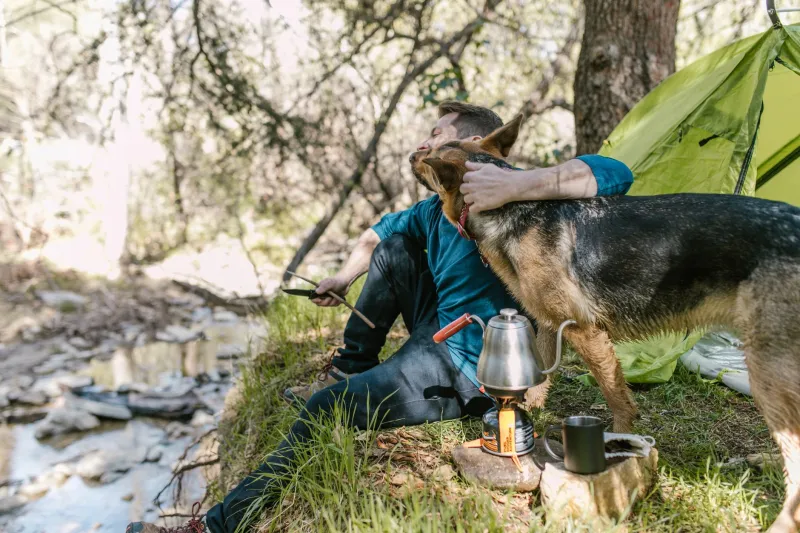
Bring your own bowl regardless — a collapsible silicone one weighs nothing and clips to a rucksack — plus a spare bottle for the walk back to the tent. Festival fields in August are shadeless places, and grass baked for three days stops being cool underfoot. If the site is mostly open pasture with a single oak at one end, plan your afternoons around that oak rather than around the line-up.
Watch out for standing water, too. Dorset's summer ponds and slow streams are a genuine blue-green algae risk in warm spells, and a festival field's drainage pond is not the place for a swim, however hot it gets.
Ground, gates and the great gazebo question
Dorset's festival sites are mostly working farmland, and that shapes dog welfare more than any rule. Chalk downland drains fast and gets flinty; clay vales hold water for days. A site that was fine for paws on Friday can be a bog by Sunday afternoon, and a dog sinking to the hocks is a dog that's going to have a miserable time and a skin problem.
Gates matter as much as ground. Sites with double-gated entrances, or a strip of fencing between the campsite and the road, have thought about a dog slipping a collar in a crowd. Sites that open directly onto a lane with a 60mph limit have not. If you have a dog who is a genuine flight risk, this is the single most useful thing to check — look at the site map, find the perimeter, and make your own judgement.
And yes, the gazebo question. Most festivals ban them for fire-safety reasons; a few allow a small day-shelter in family camping. That small patch of shade can transform a hot Saturday, so it's worth an email.
Walk first, wristband second
Here's the routine that works: arrive, pitch, water, then walk before you ever set foot in the arena. A dog who's had a proper sniff and a proper wee is a dog who'll lie down under a table while you eat a disappointing burger.
Dorset is absurdly well served for this. A morning loop around Badbury Rings, a tramp through Wareham Forest on the Sika trail, a stretch of the South West Coast Path above Kimmeridge or around Corfe, or the flat miles of the Stour Valley near Wimborne — all give you a decent leg-stretch within reach of most festival sites. If you're on the coast, remember that several main Dorset beaches, Weymouth and Swanage included, restrict dogs between May and September, so check before you plan a sea swim. Arne and the heathland reserves also ask for leads or restrict access in ground-nesting bird season. Sheep, ponies and livestock are a live issue across Purbeck, and a lead is not optional there whatever the festival says.
Crowds, noise and knowing when to leave
A festival on a working farm in rural Dorset is a lot for an animal that's used to the same lane every morning. Dusk, a headline set and ten thousand people is the hardest moment, not the easiest. Give a dog a quiet spot to retreat to — a crate under a tarp, a tent with the mesh zipped, a familiar blanket — and never leave them in a hot car, ever, not for twenty minutes, not in the shade.
Be honest about your own dog, too. If they're reactive to other dogs, a field full of them is not the gentle introduction you're imagining. Some events run quiet-hours camping or a separate family field that is more forgiving; ask.
The etiquette that keeps the gate open
This bit is on us. Bag it, carry it, bin it — and don't leave the bagged version hanging from a hedge like a grim Christmas bauble. Keep off the marked hay meadows. Don't let a dog into a food tent, however well-behaved. Don't tie a lead to a tent guy-rope and disappear. Short leads in crowds, and a torch on the collar after dark so nobody trips over a sleeping lurcher at midnight.
Make sure vaccinations and kennel cough cover are current, the microchip details are up to date, and the tag has a mobile number on it — festival signal is patchy and a landline is useless when you're in a field near Sixpenny Handley.
Festivals read their feedback. If a site got its dog arrangements right this year, tell them. If it didn't, tell them that too, politely, in November rather than in a rage on the Monday. That's how next summer's policy gets written — and how the good ones stay good.